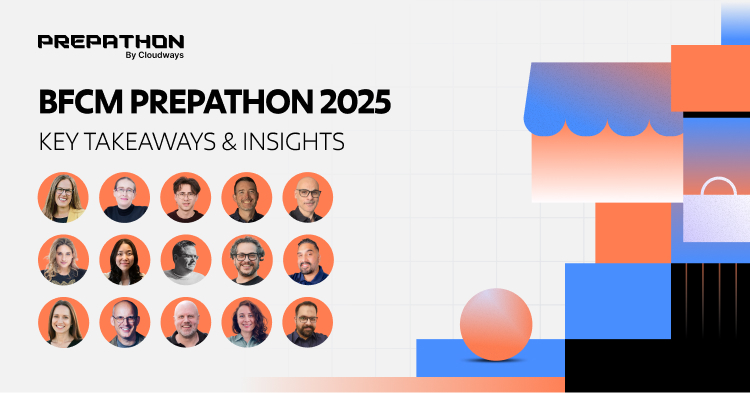
This year, the fifth edition of Prepathon saw leading industry experts come together for a three-day event exploring the future of eCommerce through the lens of Gen Z and Gen Alpha consumer expectations. Featuring a cross-section of more than 20 experts from across web development, commerce, marketing services, and consumer behaviour, our speakers brought their unique perspectives on how online commerce is evolving in the AI era.
Prepathon 2025 saw more than 5,100 people register from around the world, and the online attendees spent an average of 5.1 hours discovering how the industry is evolving through new market dynamics and behavioral changes among consumers. The key takeaway was clear: the future of online commerce is a blend of the need for speed, deep trust in vendors and merchants, and AI-ready strategies that can capitalize on the opportunity present.
Missed Prepathon 2025? We’ve distilled the most essential insights you need to know from the sessions presented. Read on to learn more!
1. Speed, Trust, and User Experience
Is your website fast enough? Think again.
In his keynote, Fatih Mehtap, VP of Marketing at DigitalOcean, emphasized the 2-second rule as mission-critical; every moment of delay risks losing customer attention. This isn’t just an opinion; it’s backed by data.

– Source: Cloudways
In their panel discussion, Suhaib Zaheer, SVP of Managed Hosting at DigitalOcean, and Ali Ahmed Khan, Sr. Director of Product Management at DigitalOcean, revealed that 53% of mobile visitors will leave a website if the page takes longer than 3 seconds to load. Slow speeds don’t just frustrate users; they directly result in lost sales.
They concluded by emphasizing that having a reliable and scalable server infrastructure is essential to deliver a successful user experience. Hosting performance directly ties speed to revenue, security, and uptime. Faster websites convert more visitors, secure environments protect customer privacy, and consistent uptime keeps businesses running smoothly.
But speed alone isn’t enough.
As Bogdan Condurache, Co-Founder & CPO at Brizy, and Raitis Sevelis, Head of Product at WPBakery, argued, “Less is more.” A minimalist design reduces distractions and cognitive load, guiding users smoothly towards a purchase.
This philosophy directly tackles common friction points in a customer’s online shopping journey, as highlighted by Katie Keith, Founder at Barn2, such as:
- “Make it easy to find products”
- “Shop layouts that minimize clicks”
- “Intuitive product options”
- “Streamline the cart and checkout”
By combining site speed with a clean, intuitive user experience, you build a foundation of trust and performance, where conversions can thrive.
2. Beyond Guesswork to Human Connection
Are you stuck on “testing the hamster wheel”?
Talia Wolf, CEO at Getuplift, challenged this approach, where random changes and copied best practices can sometimes lead nowhere. The solution is Strategic CRO (Conversion Rate Optimization). “Move from ‘what should we test?’ to ‘what problem are we solving?'” she urged. This means using customer research to understand the why behind customer behavior.
A great example comes from the Think with Google study, “From Promotion to Emotion: Connecting B2B Customers to Brands.” The research found that B2B buyers are 50% more likely to make a purchase and 8x more likely to pay a premium when they perceive personal value in a brand.
– Source: Think with Google
This shift in perspective aligns perfectly with the UX Strategist at Boagworks, Paul Boag’s method for creating “Functional Personas.” He advises focusing on user goals, questions, and touchpoints to build a “living toolkit” that directly informs your site’s navigation, content, and CTAs.
But strategy must connect emotionally. Christian Helms, Founder & Creative Director at Helms Workshop, argued that to stand out, you must defy the trashcan by creating brands worth keeping. He stated that the goal isn’t just to make a sale; it’s to create a brand that defies the trashcan.
Building a personal brand isn’t vanity; it’s a trust engine that drives sales. It’s about creating moments of wonder that move beyond transactions to form emotional connections.
Kelly Schuknecht, Chief Elevation Officer at Two Mile High Marketing, points to a report in CEO Hangout which found that “82% of people are more likely to trust a company when its senior executives are active on social media.”
An effective strategy also means recovering lost sales intelligently. As Matias Mancheno, Customer Success Manager at Omnisend, and Ian Misner, Co-founder of Kestrel, explained, abandonment flows should go beyond discounts. “Do not train your customers to expect a discount. It’s one of the worst things you can do,” Ian Misner warned.
Instead, focus on building value and trust through personalized reminders, free shipping, social proof, and a sense of scarcity. These approaches encourage customers to return because they believe in the brand, not just the price.
3. A Practical Guide to the AI Revolution
Your next customer might not be a person at all.
Sonja Ibele, Delivery & Account Manager at Syde, revealed how AI agents now orchestrate the entire purchase journey. “A user asks an AI, ‘I need a new toy for my dog, budget $15,'” she explained. “The AI finds, evaluates, and can even purchase the item directly.”
This shift is already happening as Twilio’s fifth-annual “State of Personalization” report shows that “89% of business leaders say personalization is essential to their success over the next three years.” The implication is stark: if AI agents can’t understand your products, you’re invisible.
So, how should brands respond?
Miriam Schwab, Head of WordPress at Elementor, and Vito Peleg, Co-founder & CEO at Atarim, provided a reality check, emphasizing that AI is a powerful tool for augmentation and scaling, not a replacement for human strategy. Focus on what works: using AI as a copilot to scale human effort in support and to power intent-based personalization.
Heather Dawson, Founder of Perspective Growth Partners, reinforces this point with data from McKinsey’s Report, “Next in Personalization 2021”: The study found that “Companies using…personalization see 40% more revenue,” highlighting the tangible payoff of a strategic AI approach.
– Source: Meeky Hwang / Ndevr
To build an AI-ready foundation, Meeky Hwang, CEO at Ndevr, emphasizes the importance of the “3E Framework.” A strong platform must balance Audience Experience (through AI-powered search), Creator Experience (with AI content tools), and Developer Experience (using AI coding assistants and testing).
Expanding on this idea, Sonja Ibele outlined how brands can start preparing for this new era of agentic commerce:
- Provide great customer service to earn positive reviews and ask satisfied customers for testimonials.
- Use structured data and clear FAQs so AI agents can easily find and understand your products.
- Speed up your website and checkout process; AI agents won’t wait for slow pages.
- Display visible trust and security badges so AI and shoppers know your site is safe.
As Vito Peleg perfectly summarized, “We’re all becoming prompt engineers in the modern world. Our job is no longer to do the task, but to orchestrate the fleet of AI agents that can do it at a scale we never could alone.”
4. Gen Z and The Overlooked Majority
While many brands chase Gen Z, are you perhaps ignoring your most valuable customers? The data reveals a surprising truth.
According to Janis Thomas, eCommerce & Subscriptions Expert at Look Fabulous Forever, women over 50 control 95% of their household purchasing decisions and hold 70% of the UK’s disposable income. “This isn’t just an oversight; it’s a massive opportunity,” she stated.
– Source: Janis Thomas / Look Fabulous Forever
Meanwhile, Gen Z requires a completely different playbook. Grant McAngus, Founder at Bad Brain Media, explained that Gen Z sees social media as a playing field, not a broadcast channel. They actively participate, with 29% of users regularly commenting. Fatih Mehtap also added that 75% read comments and 72% check product reviews before trusting a brand.
The winning formula:
- Gen Z participates in their culture with the 70/30 rule: 70% brand-building content, 30% commerce.
- For the older demographic, build community and offer exceptional service. Success lies not in chasing one group, but in understanding how to authentically engage both.
5. Preparing for Peak Seasons (BFCM)
When Black Friday/Cyber Monday (BFCM) hits, is your store ready for the pressure?
The expert panel featuring James Kemp, Core Product Manager at Woo, Chris Badgett, Founder & CEO at LifterLMS, and Andrew Comb, WooCommerce Merchant, gave a clear battle plan.
Chris Badgett set the tone with this powerful advice: “When it comes to Black Friday discounts, do more than you’re comfortable with. It’s a powerful customer acquisition tool, and if your margins are right, it’s still profitable.” Think 50-60% off to make a real impact.
But generosity without preparation is dangerous.
The panel emphasized that margin awareness is critical across all your products and platforms. James Kemp and Andrew Comb highlighted the importance of using a project management system to avoid disorganization and rigorously control margins across complex product lines.
During the sale, create urgency with low-stock warnings and leverage tools to monitor your site’s uptime constantly. Remember, for a site doing $1M/month, even with 99.99% uptime, downtime can still cost nearly $39,000 every month.1
After the frenzy ends, avoid the biggest mistakes. As Andrew Comb advised, set a calendar reminder for after the sale to review performance and end promotions promptly. Your BFCM success depends on equal parts bold offers and strong planning.
Conclusion: Tying It All Together
The future of eCommerce isn’t about choosing one strategy; it’s about connecting an increasingly fragmented eCommerce journey through well-orchestrated experiences:
- Connection through lightning-fast experiences powered by web hosting that delivers sub-3-second load times.
- Connection through developing a strategic understanding of customer needs and meeting them where they need you to.
- Connection through AI tools that enhance our ability as consumers to find the answers we need quickly and efficiently.
Start with the foundational aspects. Prioritize performance and optimize the UX of your site to make it easy for customers to transact with you. Then build from there.
You can rewatch all the sessions from Prepathon 2025 on demand on our website.
1 https://uptimerobot.com/free-tools/uptime-downtime-calculator/
Mansoor Ahmed Khan
Been in content marketing since 2014, and I still get a kick out of creating stories that resonate with the target audience and drive results. At Cloudways by DigitalOcean (a leading cloud hosting company, btw!), I lead a dream team of content creators. Together, we brainstorm, write, and churn out awesome content across all the channels: blogs, social media, emails, you name it! You can reach out to me at [email protected].