Key Takeaways
- PHP powers around 72.2% of all websites, underscoring its dominance in web development.
- Major versions like PHP 5, 7, and 8 introduced key improvements in performance, security, and syntax.
- PHP 8.x brought modern features like JIT compilation, union types, and named arguments.
- Keeping your PHP version updated is essential for security, speed, and compatibility.
- Understanding PHP’s evolution helps developers make better infrastructure and codebase decisions.
PHP has come a long way since it first appeared in the mid-90s. What started as a simple set of tools for building personal websites has grown into one of the most widely used programming languages across the web. As of Feb 2026, around 72.2% of all websites still run on PHP, a strong sign of how deeply it’s rooted in web development.
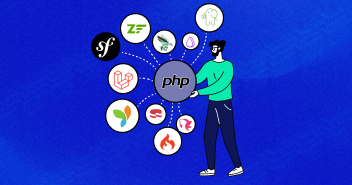
Part of PHP’s staying power comes from its balance of simplicity and flexibility. Popular frameworks like Laravel, Symfony, and CodeIgniter have helped keep it modern and practical for developers of all levels.
Tracking PHP versions over time is important for developers and site owners alike. It ensures optimal performance, maintains security, and guarantees compatibility with modern frameworks and plugins. Understanding the PHP version history helps developers plan upgrades, avoid deprecated features, and leverage the latest improvements effectively.
This blog looks at how PHP has evolved over the years, highlighting each version’s key updates, how performance and security have changed, and what developers can expect as the language continues to move forward.
Why PHP Version History Matters for Your Website
The journey began in 1994 with the birth of PHP/FI (Personal Home Page/Forms Interpreter), created by Rasmus Lerdorf, who released its first version in 1995. PHP 7 bringing major performance improvements, and PHP 8 adding modern features like JIT compilation and typing, shaping the execution model used today.
PHP version history serves as a roadmap highlighting the progress and improvements made to the language over time. Each new release brings enhanced features, performance optimizations, security updates, and improvements in backward compatibility.
Tracking PHP versions offers several key benefits: it helps developers ensure their websites run faster, remain secure against vulnerabilities, and stay compatible with modern frameworks, plugins, and hosting environments.
Developers can use these advancements to build more efficient, secure, and powerful web applications by staying up-to-date with the latest PHP versions. Neglecting to update PHP leaves applications vulnerable to known security risks, potentially exposing sensitive data and compromising system integrity.
In short, the PHP version history is a valuable resource for developers and website owners to stay informed, maintain site performance, and safeguard against security threats.
Run PHP 8.4 (Or Any Legacy Version) Effortlessly
✓ Switch PHP versions in 1 click
✓ Auto-test compatibility with your codebase
✓ Free downgrade protection for legacy apps
✓ Security patches for older PHP versions
PHP Versions Timeline: From PHP 1.x to PHP 8.x
This timeline lists all major PHP versions, including PHP 8.4 and 8.5, along with their release dates and end-of-life (EOL) schedules. Tracking PHP versions is important for performance, security, and compatibility, especially with WordPress, frameworks, and modern web applications.
| PHP Version | Release Date | Support EOL | Notes / Key Highlights |
| 1.0 | June 8, 1995 | – | Initial release, basic scripting |
| 2.0 | November 1, 1997 | – | Added new features for web forms |
| 3.0 | June 6, 1998 | October 20, 2000 | Major rewrite, modular architecture, improved extension API, early OOP support |
| 4.0 | May 22, 2000 | June 23, 2001 | Zend Engine introduced, major performance improvements, superglobals |
| 5.0 | July 13, 2004 | September 5, 2005 | Object-oriented programming support |
| 5.1 | November 24, 2005 | August 24, 2006 | Improved database support |
| 5.2 | November 2, 2006 | January 6, 2011 | Security updates, JSON support |
| 5.3 | June 30, 2009 | August 14, 2014 | Namespaces, late static binding |
| 5.4 | March 1, 2012 | September 3, 2015 | Traits, short array syntax |
| 5.5 | June 20, 2013 | July 10, 2016 | Generators, finally keyword |
| 5.6 | August 28, 2014 | December 31, 2018 | Last PHP 5 branch; legacy WordPress compatibility |
| 7.0 | December 3, 2015 | December 3, 2018 | Major performance improvements, scalar type hints |
| 7.1 | December 1, 2016 | December 1, 2019 | Nullable types, iterable pseudo-type |
| 7.2 | November 30, 2017 | November 30, 2020 | Libsodium, improved security |
| 7.3 | December 6, 2018 | December 6, 2021 | Flexible Heredoc/Nowdoc syntax |
| 7.4 | November 28, 2019 | November 28, 2022 | Typed properties, arrow functions |
| 8.0 | November 26, 2020 | November 26, 2023 | JIT compilation, union types |
| 8.1 | November 25, 2021 | November 25, 2024 | Fibers, enums, readonly properties. End of Life |
| 8.2 | November 24, 2022 | November 24, 2025 | Readonly classes, DNF types. End of Life |
| 8.3 | November 23, 2023 | November 23, 2026 | Typed class constants, #[\Override] attribute. Security-fix-only phase |
| 8.4 | November 21, 2024 | November 23, 2028 | Property hooks, asymmetric visibility. Active support |
| 8.5 | November 20, 2025 | November 23, 2029 | Current stable release; Pipe operator, Clone With, #[\NoDiscard], array_first()/array_last(), CLI and debugging improvements |
Please note that the mentioned support EOL dates for version 8.x follow PHP’s standard support policy and may be subject to change.
Notes:
- PHP 5.x → End of Life. Suitable only for legacy applications that cannot be upgraded.
- PHP 7.x → End of Life. Introduced major performance improvements and Composer adoption.
- PHP 8.x → Modern PHP with JIT, strong typing, improved performance, and enhanced developer tooling.
- The latest stable PHP release is 8.5. PHP 8.4 remains in active support. PHP 8.3 is in security-fix-only mode.
See Performance Optimization Applied Live
On Mar 10–11, 20+ experts walk through real WordPress sites and explain each optimization decision as they make it.
Free & Live Performance Bootcamp on Mar 10-11.
Major PHP Versions to Date
Let’s explore the evolution of PHP versions and the features they introduced over the years, from the earliest releases to the latest stable versions. Understanding these updates is essential for ensuring website compatibility, maximizing performance, and leveraging modern CMS platforms like WordPress, Laravel, and tools like Composer.
Each major PHP release has brought improvements in speed, security, and language features, helping developers build more efficient and reliable web applications. Tracking the PHP version history allows you to plan upgrades, maintain plugin and framework compatibility, and avoid deprecated features that could break your site.
PHP/FI (June 1995) – The Beginning of PHP
Initially known as Personal Home Page (PHP), PHP/FI was written in C-language as a PERL/CGI script toolset. This early version laid the foundation for dynamic web development, allowing developers to build interactive websites at a time when most sites were static.
Features of PHP/FI
- Built-in support for mSQL, DBM, and Postgres95 databases
- User-defined functions and cookies
PHP/FI played a crucial role in shaping the early web and is considered the first step in the PHP version release history. It’s also one of the notable PHP early versions that introduced server-side scripting for web applications.
PHP/FI 2 (November 1997) – Form Handling & HTML Embedding
PHP/FI 2 introduced form handling and HTML embedding, enabling developers to use HTML tags directly within PHP code. This version significantly influenced the creation of dynamic web pages, making it easier to generate interactive content and process user input efficiently.
PHP 3 (June 1998) – Introduction of Modular Architecture
PHP 3 was a major rewrite of the language that introduced a modular architecture, making it easier to extend functionality through additional modules. It also expanded support for object-oriented programming, laying the groundwork for more structured and scalable web application development.
Features of PHP 3
- API Extension for easier module integration
- Object-Oriented Support for classes and basic OOP concepts
PHP 4 (May 2000) – Enhanced Runtime & Superglobals
PHP 4 brought significant improvements in runtime execution and resource handling, making web applications more efficient and robust. This version introduced superglobals, a web server abstraction layer, and output buffering, which allowed better control over data flow and server interactions. It also added object overloading support, enhancing PHP’s flexibility for developers.
Features of PHP 4
- Enhanced runtime execution for faster performance
- Introduced superglobals for easier variable access
- Web server abstraction layer for compatibility across servers
- Object overloading support for advanced programming
- Output buffering support to manage server responses efficiently
PHP 5.0 (July 2004)
PHP 5.0 focused on language maturity and introduced PDO extension, rewritten XML functionality, and upgraded Zend Engine.
Features of PHP 5.0
- PDO extension for database connectivity
- Rewritten XML functionality
- Upgraded to Zend Engine II
PHP 5.1 (November 2005) – Bug Fixes & Autoloading Support
PHP 5.1 focused on improving stability and performance while introducing custom autoloading capabilities. It also included over 400 bug fixes, enhanced timezone support, and optimized data handling, making it a more reliable choice for web applications, including WordPress compatibility.
Features of PHP 5.1
- Support for custom autoloading for easier class management
- Over 400 bug fixes enhancing stability
- Significant performance improvements
- Improved timezone support for consistent date and time handling
PHP 5.2 (November 2006) – JSON & Input Filtering
PHP 5.2 focused on improving stability, memory management, and introducing modern web development features. Key updates included enhanced error handling, JSON support, and a new input filtering extension, along with upgraded bundled SQLite and Zip extensions.
Features of PHP 5.2
- Improved memory manager for better performance
- Increased default memory limit
- New extensions: JSON, Zip
- Input filtering extension for secure data handling
- Upgraded bundled SQLite
PHP 5.3 (June 2009) – Namespaces & Nowdoc
PHP 5.3 introduced features that modernized PHP for large-scale applications, including namespace support, late static binding, and Nowdoc syntax. It also marked several major deprecations to clean up legacy behavior.
Features of PHP 5.3
- Namespace support for organized code
- Late static binding for OOP flexibility
- Jump labels and Nowdoc support
- Deprecation of call-time pass-by-reference and several legacy functions
Deprecations in PHP 5.3
- INI directives: define_syslog_variables, register_globals, register_long_arrays, safe_mode, magic_quotes_gpc, magic_quotes_runtime, magic_quotes_sybase
- Comments starting with # in .INI files
- call_user_method() function
- call_user_method_array() function
- define_syslog_variables() function
- dl() function
- ereg() function
- ereg_replace() function
- eregi() function
- eregi_replace() function
- set_magic_quotes_runtime() and its alias, magic_quotes_runtime() function
- session_register() function
- session_unregister() function
- session_is_registered() function
- set_socket_blocking() function
- split() function
- spliti() function
- sql_regcase() function
- mysql_db_query() function
- mysql_escape_string() function
- Passing locale category names as strings
- is_dst parameter to mktime()
- Assigning the return value of new by reference
- Call-time pass-by-reference
PHP 5.4 (March 2012)
PHP 5.4 introduced traits, short array syntax, improved parse error messages, and support for a binary number format.
Features of PHP 5.4
- Trait support for reusable code
- Short array syntax ([])
- Improved parse error messages
- Binary number format support
Deprecations in PHP 5.4
- mysql_list_dbs() function
PHP 5.5 (June 2013)
PHP 5.5 brought new features like generators, bundled ZendOptimizer, and a new password hashing API.
Features of PHP 5.5
- Generators for memory-efficient loops
- Bundled ZendOptimizer
- Password Hashing API for secure authentication
- finally keyword for exception handling
Deprecations in PHP 5.5
- ext/mysql
- preg_replace() /e modifier
- Intl: IntlDateFormatter::setTimeZoneID() and datefmt_set_timezone_id()
- Mcrypt: mcrypt_cbc(), mcrypt_cfb(), mcrypt_ecb(), mcrypt_ofb()
PHP 5.6 (August 2014)
PHP 5.6 introduced constant expressions, an interactive debugger (Phpdbg), improved character encoding, and enhanced file upload capabilities.
Features of PHP 5.6
- Constant expressions
- Interactive debugger (Phpdbg)
- Improved character encoding
- Enhanced file upload capabilities
Deprecations in PHP 5.6
- Calls from incompatible context
- $HTTP_RAW_POST_DATA and always_populate_raw_post_data
- iconv and mbstring encoding settings (iconv.input_encoding, iconv.output_encoding, iconv.internal_encoding, mbstring.http_input, mbstring.http_output, mbstring.internal_encoding)
PHP 7.0 (December 2015) – Scalar Types & Performance Boosts
PHP 7.0 significantly improved scalar type declarations, return type declarations, null coalescing operator, and spaceship operator.
Features of PHP 7.0
- Scalar type declarations for stricter type checking
- Return type declarations
- Null coalescing operator (??)
- Spaceship operator (<=>) for comparisons
Deprecations in PHP 7.0
- PHP 4 style constructors
- Static calls to non-static methods
- password_hash() salt option
- capture_session_meta SSL context option
- LDAP: ldap_sort() function
PHP 7.1 (December 2016)
PHP 7.1 introduced nullable types, void functions, symmetric array destructuring, class constant visibility, and asynchronous signal handling.
Features of PHP 7.1
- Nullable types
- Void functions
- Symmetric array destructuring
- Class constant visibility
- Asynchronous signal handling
Deprecations in PHP 7.1
- ext/mcrypt
- e pattern modifier for mb_ereg_replace() and mb_eregi_replace()
PHP 7.2 (November 2017)
PHP 7.2 added password hashing, a new object type, method overriding and deprecated the autoload() method and create_functions.
Features of PHP 7.2
- Password Hashing
- New Object Type
- Method overriding
Deprecations in PHP 7.2
- __autoload() function
- $php_errormsg variable
- parse_str() without a second argument
- assert() with a string argument
- gmp_random()
- each() function
- create_function()
PHP 7.3 (December 2018)
PHP 7.3 introduced features like trailing commas in function calls and flexible heredoc/nowdoc syntaxes.
Features of PHP 7.3
- Trailing comma
- Flexible Heredoc and Nowdoc Syntaxes
- PCRE2 Migration
- JSON_THROW_ON_ERROR
Deprecations in PHP 7.3
- Case-insensitive constants
- image2wbmp() function
- FILTER_FLAG_SCHEME_REQUIRED and FILTER_FLAG_HOST_REQUIRED flags used with FILTER_VALIDATE_URL
- Unparenthesized expressions containing ‘.’ and ‘+/-‘ both
PHP 7.4 (November 2019)
PHP 7.4 brought typed properties, underscore numeric separator, and minor improvements.
Features of PHP 7.4
- Typed Properties
- Underscore Numeric Separator
- Minor syntax and performance improvements
Deprecations in PHP 7.4
- Curly Brace Syntax for Array Access
- real Type
- Magic Quotes and Register Globals (residual references/usage)
- MBString Functions Without Explicit Encodings
PHP 8.0 (November 2020) – JIT & Union Types
PHP 8.0 introduced union types, JIT compilation, constructor property promotion, match syntax, and named parameters. You can check out our blog on PHP 8 to learn more.
Features of PHP 8.0
- Union Types – Allows variables and functions to accept multiple types
- JIT Compilation – Just-In-Time compilation for faster runtime performance
- Constructor Property Promotion – Simplifies class property declarations
- Match Syntax – More expressive alternative to switch statements
- Named Parameters – Call functions with explicit parameter names
Deprecations in PHP 8.0
- PostgreSQL: Several aliased functions
- Required parameters after optional parameters in function/method signatures
- ReflectionParameter::getClass(), ::isArray(), and ::isCallable() methods
- Disabled functions: Reflection and get_defined_functions() deprecations
- libxml_disable_entity_loader function
PHP 8.1 (November 2021) – Enums & Fibers
PHP 8.1 added enums, fibers, never return types, intersection types, and readonly properties.
Features of PHP 8.1
- Enums – Native support for enumerations
- Fibers – Lightweight concurrency mechanism
- Never Return Type – Explicit non-returning functions
- Intersection Types – Combine multiple types
- Readonly Properties – Immutable object properties
Deprecations in PHP 8.1
- Passing null to non-nullable internal function parameters
- Return types in PHP built-in class methods and deprecation notices
- Serializable interface
- Implicit incompatible float to int conversion
- mhash*() functions (hash extension)
- mysqli::get_client_info method and mysqli_get_client_info($param)
- date_sunrise, date_sunset functions and related INI settings
- strptime function
- strftime and gmstrftime functions
- filter.default and filter.default_options INI settings
- PDO::FETCH_SERIALIZE
- auto_detect_line_endings INI directive
- MySQLi: mysqli_driver->driver_version property
PHP 8.2 (December 2022) – Readonly Classes & DNF Types
PHP 8.2 introduced readonly classes, DNF types, null, false, and true types, sensitive parameter redaction support, and a new random extension.
Features of PHP 8.2
- Readonly Classes – Make entire classes immutable
- DNF Types – Disjunctive Normal Form for type declarations
- Null, False, and True Types
- Sensitive Parameter Redaction Support
- New Random Extension
Deprecations in PHP 8.2
- Dynamic Properties
- utf8_encode() and utf8_decode() Functions
- ${var} String Interpolation
- Partially-supported callable patterns
- Mbstring extension’s handling of Base64, Uuencode, QPrint, and HTML Entity encodings
PHP 8.3 (November 2023) – Typed Class Constants & Overrides
PHP 8.3 introduces powerful improvements, including typed class constants, support for deep-cloning readonly properties, and several additions to the randomness extension. It also brings quality-of-life features like the new #[\Override] attribute, a native json_validate() function, and extended support for command line tools. With performance enhancements and language cleanups, PHP 8.3 continues pushing modern PHP development forward.
Features of PHP 8.3
- Typed Class Constants
- #[\Override] Attribute – Explicit method overriding
- Deep-Cloning of Readonly Properties
- json_validate() Function
- Extended Randomizer Methods (getBytesFromString(), getFloat(), nextFloat())
- Dynamic Class Constant Fetch & Command Line Linter for Multiple Files
Deprecations in PHP 8.3
- get_class() and get_parent_class() function calls without arguments
- Assert: assert_options(), ASSERT_* constants, and assert.* INI settings
PHP 8.4 (November 2024) – Property Hooks & Asymmetric Visibility
PHP 8.4 is a major update to the PHP language, bringing significant enhancements and new functionalities. It contains many new features, such as property hooks, asymmetric visibility, an updated DOM API with HTML5 support, new array functions, an object API for BCMath, and PDO driver-specific subclasses. This version also includes numerous performance improvements, bug fixes, and general cleanup.
Features of PHP 8.4
- Property Hooks – Custom behaviors on property access
- Asymmetric Visibility – Fine-grained access control
- #[\Deprecated] Attribute – Standardized deprecation marking
- New ext-dom features with HTML5 support
- Object API for BCMath operations
- New array_*() functions for easier array handling
- PDO Driver-Specific Subclasses
- new MyClass()->method() without parentheses
Deprecations in PHP 8.4
- Implicitly nullable parameter declarations
- E_STRICT constant
- Calling session_set_save_handler() with more than 2 arguments
- CSV: The $escape parameter must be provided
- SUNFUNCS_RET_* constants
- Curl: CURLOPT_BINARYTRANSFER
PHP 8.5 (November 2025) – Pipe Operator & Debugging Enhancements
PHP 8.5 was released in November 2025 and introduced several new features aimed at improving code readability, debugging, and overall development experience.
Features of PHP 8.5
- Pipe Operator (|>) – Functional-style chaining of expressions
- New array_first() and array_last() functions
- New get_exception_handler() and get_error_handler() functions
- Stack trace support for PHP fatal errors
- Locale utilities: locale_is_right_to_left() and Locale::isRightToLeft()
- CLI enhancements: php –ini=diff to show non-default INI directives
- Intl: New IntlListFormatter class
Deprecations in PHP 8.5
- All MHASH_* constants are deprecated
Why PHP 8.4 Outperforms Older Versions
Our hosting unlocks PHP 8.4 benefits:
✓ 50% faster execution vs PHP 7.4
✓ Built-in JIT compiler & OPcache
✓ Prevents 80% of CVEs in older PHP
PHP Performance Enhancements
Speed and reliability are major reasons developers upgrade to newer PHP versions. Each update—whether major or minor—typically brings performance boosts that help applications run faster and more efficiently.
PHP 7.3, for example, delivered clear improvements in execution time across many content management systems. PHP 8 continued to build on that, with most versions performing slightly better than 7.4, which showed about 5% fewer requests per second.
PHP 8.4 keeps things moving in the right direction with updates that improve execution speed and reduce memory usage.
These gains matter, especially for resource-heavy websites and busy applications that handle large amounts of traffic.
On top of better performance, each new version strengthens security by patching known issues. It also brings access to modern features and ensures ongoing community support—something older versions eventually lose.
Current Stable Version of PHP
The current stable release is PHP 8.5.2, released on January 15, 2026. PHP 8.5 became generally available in November 2025 and is now the actively supported stable branch for production environments.
PHP 8.5 continues the language’s evolution with improvements focused on developer experience, cleaner syntax, stronger type safety, and better debugging capabilities.
Key features of PHP 8.5 include:
- Pipe Operator (|>) – Enables functional-style chaining of expressions for cleaner and more readable code.
- Clone With – Allows cloning an object while modifying selected properties in a single expression.
- #[\NoDiscard] Attribute – Emits warnings when return values marked as important are ignored.
- Closures in Constant Expressions – First-class callables and closures can now be used in constant contexts.
- New Array Helpers – Includes array_first() and array_last() for simplified array handling.
- Improved Error & Exception Handling – New get_exception_handler() and get_error_handler() functions.
- Enhanced Stack Traces – Better visibility into fatal errors and debugging information.
- CLI Improvements – New php –ini=diff option to quickly compare modified INI settings.
- Intl Enhancements – Introduction of the IntlListFormatter class.
- Locale Utilities – New locale_is_right_to_left() and Locale::isRightToLeft() helpers.
Support Status
- PHP 8.4 remains in active support but is no longer the latest branch.
- PHP 8.3 and older versions are in security-fix-only mode or have reached end-of-life.
- PHP 7.x and earlier versions are fully end-of-life and should not be used in production.
Upgrading to PHP 8.5 ensures improved performance, stronger security, ongoing community support, and access to the latest language enhancements. Keeping your PHP environment up to date remains essential for maintaining compatibility with modern frameworks such as Laravel, Symfony, and WordPress.
Update to the Latest Supported PHP Version on Cloudways
To update your PHP version to the latest supported version available on Cloudways (currently PHP 8.4), follow these simple steps:
- Log in to the Cloudways Platform.
- Select your server, which will redirect you to the Server Management.
- Navigate to Settings & Packages → Packages.

- Locate your current PHP version and click the Edit button next to it.
- From the drop-down menu, select PHP 8.4.
- Click Save.
- Voila! Your PHP version will be updated to 8.4 in no time.
Following these steps, you can effortlessly upgrade your PHP version on Cloudways and take advantage of the latest features and improvements.
Conclusion
Throughout this blog, we’ve looked at PHP’s progression from its early versions to PHP 8.5. We covered key changes across major and minor releases, including newly introduced features, performance improvements, and deprecations that affect how developers write and maintain code.
With PHP 8.5 now as the current stable release, the language continues to mature with updates that improve clarity, consistency, and usability. From refined type handling to property hooks, the pipe operator, and extended standard libraries, these changes are part of PHP’s steady effort to support modern development practices.
As PHP continues to evolve beyond 8.5, staying current with the latest versions remains important, not only to take advantage of new capabilities, but also to ensure ongoing compatibility and security.
Frequently Asked Questions
1. Are there any compatibility issues when upgrading from older PHP versions to newer ones?
Compatibility issues may arise due to syntax changes, deprecated features, or default behavior modifications. Reviewing PHP migration guides and release notes helps identify potential issues and required code adjustments.
2. When was PHP first released, and who created it?
PHP was first released in June 1995 by Rasmus Lerdorf as a set of Perl scripts to track visits to his online resume. It evolved into a full programming language powering millions of websites today.
3. Which version of PHP is the best?
As of 2026, PHP 8.5 is the latest stable release and the recommended version for new projects. It offers improved performance, enhanced type safety, better debugging tools, and modern language features.
If your hosting provider does not yet support PHP 8.5, PHP 8.4 remains a stable and production-ready option.
4. What is the latest PHP version in 2026?
The latest stable PHP version in 2026 is PHP 8.5. It was officially released in November 2025 and is the recommended version for new projects and production environments.
5. How do I check my current PHP version?
You can check your PHP version by:
- Running
php -vin your server terminal - Using
phpinfo()in a PHP file on your server - Checking your hosting control panel (e.g., cPanel, Plesk, Cloudways)
6. How to update PHP safely?
To update PHP safely:
- Backup your website (files + database)
- Check compatibility of WordPress, plugins, themes, and custom code
- Update PHP via your hosting control panel or server package
- Test the website thoroughly after the update
7. How many versions of PHP are there?
There have been multiple major versions: 1.0, 2.0, 3.0, 4.0, 5.x, 7.x, and 8.x. Each major version includes minor releases and updates.
Abdul Rehman
Abdul is a tech-savvy, coffee-fueled, and creatively driven marketer who loves keeping up with the latest software updates and tech gadgets. He's also a skilled technical writer who can explain complex concepts simply for a broad audience. Abdul enjoys sharing his knowledge of the Cloud industry through user manuals, documentation, and blog posts.