For more than a year, agencies, developers, and customers’ technical teams have asked for deeper API access to integrate the new Cloudways features and add-ons in their automated workflows, and interact with the platform programmatically without relying on manual dashboard actions.
Today, we’re excited to introduce Cloudways API v2, a major evolution of our API that brings expanded coverage, a modern documentation experience, and a cleaner, developer-first structure. API v2 is now available to all Cloudways customers.
What’s New in Cloudways API v2?
This release expands API access to more Cloudways features and provides a clearer, more organized structure for developers who rely on the API to build tools, automate tasks, or integrate Cloudways into internal systems.
The updated API now aligns more closely with the current capabilities of the Cloudways platform, offering improved endpoint consistency and broader feature coverage. With v2, we envisioned a product that helps developers work faster, automate deeper, and create more reliable workflows.
A Modern Documentation Experience with Redocly
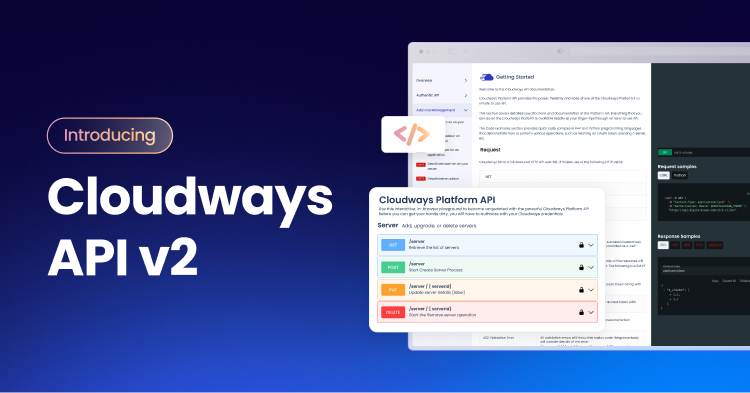
As part of the v2 release, we redesigned the entire API documentation experience. The previous Swagger-based documentation has been replaced with a modern, developer-friendly interface powered by Redocly, and now available at the Cloudways API Documentation portal.
This upgrade introduces a cleaner layout, better readability, and a structure that makes it easy to discover endpoints and understand how they work. Developers can now navigate between resources more intuitively, explore request and response schemas with greater clarity, and review technical details without friction.

The new portal also includes a dedicated API Playground.
This interactive environment lets developers test endpoints directly in the browser, explore real-time responses on servers associated with their account, and validate API behavior without setting up external tools. It creates a smoother onboarding experience and helps teams move faster when building or troubleshooting integrations.
Together, the redesigned portal and the API Playground modernize the Cloudways developer experience and enable streamlined, intuitive, and production-ready workflows.
Beyond documentation improvements, API v2 also brings the largest expansion of API surface area since the Platform API was first introduced.
New & Expanded API Endpoints
The new and expanded Cloudways API v2 endpoints give developers deeper control over applications, security, billing, and integrations.
Below is an overview of the major additions and how they help you build better automation and workflows.
Cloudways Copilot (New)
Developers and agencies can now manage Copilot subscriptions, monitor real-time usage, and automate server-level Copilot configurations.
Key capabilities:
- Manage Copilot subscription lifecycle.
- Configure Copilot settings programmatically.
- Access system insights and alerts.
Security Suite Add-on (New)
This set of endpoints gives full automation capabilities for application- and server-level security operations. You can now trigger scans, manage allowlists/blocklists, monitor incidents, restore files, and configure firewalls.
This is ideal for agencies and security teams who want continuous monitoring, automated response workflows, or custom dashboards.
Server-Level Security
- Server-wide incident monitoring
- Firewall rules configuration
- Country-level blocklist management
- Server-level IP allowlists/blocklists
App-Level Security
- Scan initiation
- Scan result retrieval
- Quarantine/restore actions
- Incident history
- File-level insights
- Event logs
- IP allowlist/blocklist management
Password Protection (New)
You can programmatically enable or update password protection (htpasswd) for any app. This is especially useful for staging sites, client previews, or pre-production environments.
WordPress Multisite (New)
Manage and enable WordPress Multisite configurations through code. Agencies managing large portfolios can now automate multisite setup across many environments.
Application Stack Version(New)
The Application Stack Version endpoint gives users direct control over switching an app between two supported web server configurations: the legacy Apache-based stack (v1) and the modern, performance-optimized NGINX-based stack (v2).
This endpoint allows teams to programmatically align apps with their preferred stack strategy, experiment with performance improvements, or revert to Apache-based behavior when compatibility is required.
Cloudflare Integration (Expanded)
Developers can now retrieve Cloudflare analytics and security logs directly from Cloudways-managed Cloudflare integration. This is ideal for building monitoring dashboards or feeding security data into Security Information and Event Management (SIEM) systems.
Application Management API (Expanded)
You can script Object Cache enable/disable actions as part of deployments or CI/CD workflows.
Client Billing & Reporting API (New)
This is one of the largest expansions in API v2, giving agencies and SaaS partners comprehensive billing system access. Users can build white-labeled dashboards, integrate Cloudways billing into their own systems, automate client invoices, and manage service subscriptions programmatically.
Vertical Scaling
You can now programmatically scale your servers with or without adding disk space.
Deprecated Endpoints From API v1
The following Bot Protection (MalCare) endpoints from API v1 are now deprecated, and will no longer receive updates or improvements.
- GET /app/malcare
- GET /app/malcare/traffic
- GET /app/malcare/traffic/summary
- GET /app/malcare/logins
- GET /app/malcare/logins/summary
- GET /app/malcare/bots/bad
- GET /app/malcare/whitelisted_ips
- GET /app/malcare/whitelisted_bots
- PUT /app/malcare/enable
- PUT /app/malcare/disable
- PUT /app/malcare/whitelist_ip
- PUT /app/malcare/whitelist_bot
Cloudways API v1 Sunset
With the release of API v2, the previous Cloudways API v1 is now deprecated. Existing users can continue using v1 during the transition period, and its documentation will remain available until March 2026.
Migration to Cloudways API v2 is simple in most cases: just replace v1 with v2 in the API call URL structure.
This ensures a smooth and interruption-free migration window for teams who rely on current implementations, while providing a clear path toward adopting the more capable and developer-friendly v2.
How to Get Started with Cloudways API v2?
Getting started with Cloudways API v2 is fast and straightforward.
1. Review the API Documentation
The complete API reference is available in a redesigned Redocly interface. You can find detailed API endpoint description and sample code snippets there.
2. Use the Cloudways API Playground
The API Playground allows you to interactively test endpoints without needing external tools. You can see the call structure and the request/response objects here.
3. Follow the Step-by-Step Getting Started Guide
For users new to the Cloudways API, we maintain a dedicated Knowledge Base article that covers how you can access API integration in the Cloudways Dashboard and generate your API key.
Interesting Automations You Can Build with Cloudways API v2
The expansion of the Cloudways API allows you to automate and build exciting new workflows and automated processes for your agency and development clients. Here are five ideas to get you started:
Copilot Automation & Smart Monitoring Pipelines
Cloudways API v2 expands what you can automate around Copilot, and application monitoring to keep environments stable and customers supported without manual oversight.
With the new endpoints, you can create workflows that:
- Automatically subscribe customers to Copilot based on usage indicators or project growth.
- Adjust support levels on demand, upgrading or downgrading plans as cost thresholds are reached.
- Build unified visibility dashboards by combining Insights summaries and alert details.
- Trigger automated notifications whenever new Insights alerts fire, enabling fast responses through Slack, Discord, or webhook-based systems.
These capabilities help agencies, SaaS teams, and fast-growing businesses build proactive support and monitoring pipelines that scale as their workloads do.
Billing, Clients, and Invoicing Automation
Cloudways API v2 introduces deeper control over billing, client records, and invoicing, giving agencies and resellers the tools they need to automate core business operations.
Using the available endpoints, you can:
- Automatically provision new clients, create services, assign pricing, and subscribe them to plans.
- Send invoice reminders programmatically, using invoice retrieval and reminder actions
- Manage tax rules and global rates, including retrieving country specifications and creating tax rates on demand
For SaaS businesses built on Cloudways, these endpoints also unlock:
- Usage-based or tiered billing models
- Custom reseller or agency dashboards that aggregate clients, plans, invoices, and tax IDs
The result is a more streamlined and automated financial workflow that’s purpose-built for high-volume resellers and service providers.
Agency Management Workflows
Cloudways API v2 strengthens how agencies onboard clients, manage billing, and maintain compliance, without increasing manual overhead across the entire lifecycle.
Agencies can now:
- Collect and validate agency tax IDs, ensuring the right compliance data is attached to each account
- Build a custom agency portal displaying services, plans, invoices, reports, and tax-related information
These improvements give agencies the flexibility to create their own branded experiences and automate internal processes while still leveraging Cloudways’ underlying infrastructure.
Security & Compliance Reporting
The new API version provides the building blocks to generate automated security and compliance reports across applications and clients. This addresses an essential requirement for agencies and enterprises with strict review cycles.
Using the available data sources, you can:
- Generate monthly or on-demand security reports, using scan results, incident logs, Cloudflare-related security data, and client reporting
- Create audit logs for long-term compliance tracking or internal governance
By enabling fully automated reporting workflows, Cloudways API v2 helps organizations maintain consistency, reduce manual review time, and strengthen their overall security posture.
Start Using Cloudways API v2 Today
Cloudways API v2 gives developers, agencies, and partners the tools they need to build powerful automations and integrate Cloudways seamlessly into existing workflows. From better documentation to broader endpoint coverage, v2 reflects our commitment to supporting modern development practices and reducing the friction associated with managing hosting operations at scale.
This is just one more step in our vision to transfer Cloudways API documentation into a developer-first hub where users can get detailed endpoint information and usage details. We will continue to extend the number of endpoints so that you can build even more exciting automated workflows in the coming days!
Explore the new documentation and start building with Cloudways API v2 today.
The possibilities for automation, integration, and innovation are now wider than ever.
Frequently Asked Questions
Q1: What is Cloudways Platform API v2?
Cloudways API v2 is the next-generation platform API that offers faster performance, consistent response structures, and a more flexible, developer-friendly experience. It enables you to automate, integrate, and manage Cloudways servers and applications programmatically.
Q2: What happens to Cloudways API v1?
API v1 is now deprecated. Existing users can continue using it until March 2026. API v1 documentation will remain available during this transition period. You can transition from v1 to v2 by replacing v1 in the API call URL paths with v2.
Q3: What are the key improvements in API v2?
API v2 introduces several new endpoints for programmatically accessing platform features such as Cloudways Copilot, User Billing & Reporting, Security Suite, and Cloudflare add-on capabilities. Bot Protection (Malcare) endpoints have been deprecated.
Q4: Can I use API v2 alongside existing API v1 scripts?
It is recommended to use v2 API endpoints for new projects to ensure you are using active in-service endpoints. For existing projects, review and replace any v1 endpoints with the corresponding v2 endpoints.
Q5: Do I need to update my integrations immediately?
No. You can transition at your own pace before the March 2026 deadline. However, planning early is recommended to take advantage of the improved reliability and developer experience in v2.
Q6: Where can I learn how to get started with API v2?
You can follow the Getting Started guide in the Cloudways Knowledge Base.
Q7: Can API v2 integrate with systems like CI/CD pipelines or monitoring tools?
Yes. API v2 works with any system capable of making HTTP requests. Users commonly integrate it with CI/CD workflows, internal dashboards, security tools, observability systems, or custom provisioning applications.
Zafar Iqbal
Zafar Iqbal is a Senior Technical Writer who's spent the last decade making server products, WordPress, and SaaS platforms actually make sense to people. As someone who lives at the intersection of tech and marketing, he loves turning complicated technical concepts into insights that help people make the right business decisions. When he's not demystifying managed hosting infrastructure, he's tinkering with his hobby projects.