Key Takeaways
- PHP frameworks provide structure, security, and speed up development.
- Choosing the right framework depends on project needs, scalability, and security.
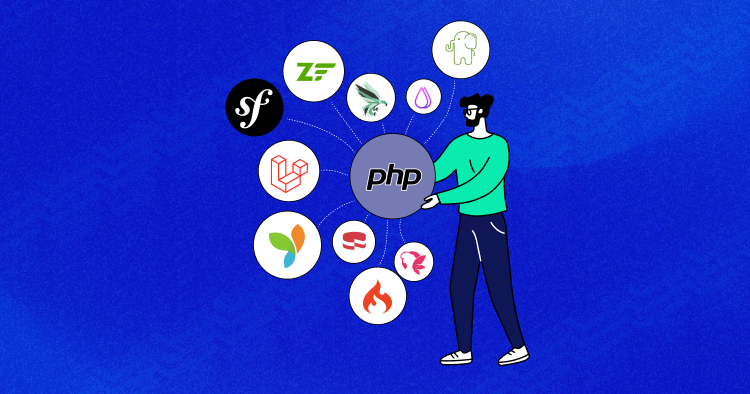
- Laravel, Symfony, and CodeIgniter are top choices for different project requirements.
- Small projects benefit from lightweight frameworks like Slim or CodeIgniter.
PHP runs most of the internet. Over 72% of websites use it in 2026. (Source: w3techs) But just knowing PHP isn’t enough.
Websites need to load fast and stay secure. That’s the bare minimum. But developers can’t keep building the same features from scratch every time. They need a faster way.
Frameworks make this possible. They handle the basic tasks, so developers don’t waste time. With frameworks, they can focus on building the parts that make a site stand out. This becomes especially important in modern web application development, where speed, scalability, and maintainability are critical. Frameworks provide a structured approach that helps teams build reliable applications faster while keeping the codebase clean and easy to manage.
We’ll walk through the top PHP frameworks for 2026. You’ll see what makes each one unique and how it can help you build better websites.
Why PHP Frameworks Are Still Important in 2026
Websites today are more complex. They handle more data, more traffic, and need to deliver faster than ever before. To understand the evolution that enabled this, see PHP version history. To keep up with these demands, developers turn to PHP frameworks.
Without frameworks, developers would be writing the same basic code again and again.
But with frameworks, common tasks like logging users in or managing security are already handled. This means developers can get straight to what makes their site stand out. For instance, providing a seamless video editor within a web application significantly enhances the user experience, allowing developers to offer high-end media tools without building them from scratch.
When a site grows and needs to handle more visitors, frameworks help keep things running smoothly. They provide structure that prevents things from falling apart as more features are added or traffic increases. Developers don’t have to worry about breaking anything—they can just focus on scaling.
With the complexity of modern websites, frameworks help developers stay organized. They give developers the tools to stay efficient while still tackling the custom needs of a site.
How to Choose the Right PHP Framework for Your Project in 2026
Picking the right PHP framework depends on what you’re building. Here’s how to decide.
What Are You Building?
For small projects like a portfolio or blog, you don’t need anything complicated. Slim and CodeIgniter are fast and easy to set up.
But if you’re working on something more complex, like an e-commerce site or a web app, Laravel or Symfony will serve you better. They offer more features and flexibility, but they come with a steeper learning curve.
How Experienced Are You?
Slim and CodeIgniter are great for beginners. They’re simple and don’t take long to get the hang of.
Laravel and Symfony are more advanced. If you’re comfortable with PHP or have a team, these frameworks give you more power and flexibility to build bigger projects.
Think About Growth
If you expect your site to grow with more visitors and more features, choose a framework that can handle that. Laravel and Symfony are built to scale. They’ll grow with your site.
For smaller sites that won’t change much, Slim and CodeIgniter are enough. They’re quick, lightweight, and won’t slow you down.
Security
Laravel comes with built-in security features like protection against SQL injection and XSS.
For Slim and CodeIgniter, you’ll need to set up your own security. It’s flexible but requires more effort.
Community Support
Laravel has one of the largest communities. If you run into issues, there are plenty of tutorials, forums, and resources.
Symfony has strong support too, especially for larger projects. Slim and CodeIgniter have smaller communities but still offer solid support for small to medium sites.
Quick Recap:
- For small projects: Slim or CodeIgniter
- For larger projects: Laravel or Symfony
- For beginners: Start with Slim or CodeIgniter
- For scalability: Laravel or Symfony
Already Built on a PHP Framework? Host It Where It Performs Best.
Move your Laravel, Symfony, CodeIgniter, or any PHP app to Cloudways for free. Get managed hosting built for speed, security, and scale with zero downtime and zero hassle.
Best PHP Frameworks in 2026 (Comparison Table)
The table below compares the top PHP frameworks in 2026:
| Framework | Release Year | Architecture | Learning Curve | Community Support | Security | Performance |
|---|---|---|---|---|---|---|
| Laravel | 2011 | MVC | Moderate | Active & Large | Strong (Built-in protections) | Efficient |
| Symfony | 2005 | Full-stack | Steep | Large & Active | Strong (Built-in protections) | Good |
| Yii 3 | 2026 | MVC | Moderate | Active | Strong | Fast |
| CodeIgniter 4 | 2020 | MVC | Easy | Active | Basic | Lightweight |
| Zend Framework (Laminas) | 2006 | Modular | Steep | Active | Strong | Scalable |
| Phalcon | 2012 | MVC | Steep | Active | Strong | Fast |
| Slim Framework | 2010 | Micro-framework | Easy | Small | Basic | Lightweight |
| FlightPHP | 2010 | Micro-framework | Easy | Small | Basic | Fast |
8 Best PHP Frameworks in 2026
When selecting the ideal PHP MVC framework for large-scale applications, consider these crucial questions:
- What functionalities and components do I want from the Framework?
- Is the framework being regularly developed?
- Is there a large community around the particular framework?
- What is the learning curve?
1. Laravel

Source: Laravel
Laravel continues to lead the PHP ecosystem in 2026. It’s easy to use and powerful, offering a range of tools to help you build fast and scalable applications. As of now, Laravel 12 is the most popular stable release, with Laravel 13 on the horizon in early 2026, bringing even better cloud support and performance improvements.
Laravel stands out for its built-in features like authentication, database management, and routing. It allows developers to focus on the unique aspects of their applications, saving time on repetitive tasks.
Pros
- Quick setup and rapid development
- Scales well for both small and large projects
- Excellent community support and resources
Cons
- Too heavy for simple websites
- Advanced features require a bit of a learning curve
Why Should You Consider Laravel PHP Platform?
You should consider Laravel PHP Platform for the following tasks:
- If you are looking for an easy-to-learn framework
- A PHP community’s favorite
- Outstanding training materials
- A simple unit for testing purposes
You might be interested in: How To Install Laravel On DigitalOcean
2. Symfony
Source: Symfony
Symfony, developed by SensioLabs, boasts a thriving community of over 300,000 developers. The Symfony development team activity provides training courses in different languages, but they update their blog regulalry to keep their large community active.
Developers highly recommend this framework for its advanced features and user-friendly environment. Symfony utilizes reusable PHP libraries, simplifying tasks such as form creation, routing authentication, object configuration, and templating.
Although Symfony has a steep learning curve due to its extensive feature set, the rapidly expanding community and numerous unofficial support groups make it easier to learn and familiarize oneself with the framework’s offerings.
Pros
- Highly flexible and customizable
- Stable and robust for large-scale enterprise applications
- Mature ecosystem with a large developer community
- Comprehensive testing framework and excellent documentation
Cons
- Increased memory consumption and performance overhead
- Reliance on code generation leads to a larger codebase and more generated files
- Dependency management considerations
Why Should You Consider Symfony?
Symfony has crossed over 500 million downloads, but here are four more reasons to go for it:
- If you seek a feature-rich framework
- Long-term support releases
- Extensive bundle library
- Official training courses and certifications
You might be interested in: How To Host Symfony On Amazon Cloud
3. Yii 3
Source: Yii
Yii 3 has officially replaced Yii 2 as the framework of choice for high-performance applications in 2026. It’s built to handle demanding applications like e-commerce or real-time data processing with speed and efficiency. Yii 3 introduces modern features and improvements, making it even more reliable for web development.
This framework is designed for developers who need fast execution and minimal overhead. Yii 3’s easy-to-use interface and built-in tools for database management make it a strong competitor in the PHP space.
Pros
- Great for high-performance applications
- Built for speed and efficiency
- Strong security features
Cons
- Less mature than other frameworks
- Still catching up with community and resources compared to others like Laravel
Why Should You Consider Yii 3?
Consider Yii 3 as a PHP framework for:
- High-performance applications that require fast execution
- Modern features like PHP 8+ support and real-time data processing
- Built-in security tools for protecting your app
- Easy integration with third-party components and services
You might be interested in: How To Host Yii 2 Framework
4. CodeIgniter 4
Source: CodeIgniter
CodeIgniter 4 remains one of the fastest PHP frameworks for building small to medium-sized applications. In 2026, it’s still a go-to for developers who need something lightweight, simple, and quick to deploy. CodeIgniter 4 is fully compatible with PHP 8+, offering performance improvements and modern tools for a seamless experience.
It’s a great choice for developers who want to quickly get started without dealing with the complexity of larger frameworks. While it’s not as feature-rich as Laravel or Symfony, its simplicity makes it ideal for fast development.
Pros
- Lightweight and fast
- Easy to learn and use
- Great for quick development
Cons
- Fewer built-in features than larger frameworks
- Limited support for complex, large-scale applications
Why Should You Consider CodeIgniter?
Consider CodeIgniter 4 as a PHP framework if you:
- Need a fast, lightweight framework for small to medium projects
- Want an easy-to-learn and quick-to-deploy solution
- Prefer a simple setup with minimal configuration
- Need excellent performance without a heavy framework
You might be interested in: How To Host CodeIgniter
5. Laminas (Zend Framework)
Source: Laminas
Laminas is the successor to the Zend Framework and continues to be a solid choice for enterprise-level applications in 2026. It’s modular, meaning you can use only the components you need, making it flexible and efficient for larger projects. Laminas works well with PHP 8+ and is regularly updated for security and performance.
Known for its security and scalability, Laminas is a great option for developers building large applications that require flexibility and longevity.
Pros
- Highly customizable
- Ideal for large, scalable apps
- Built-in security features
Cons
- Requires more setup than simpler frameworks
- Smaller community compared to frameworks like Laravel or Symfony
Why Should You Consider Laminas Framework?
You should consider Laminas Framework if you:
- Need a modular and scalable framework for large applications
- Require built-in security features for sensitive projects
- Want flexible integration with third-party components
- Need long-term support with regular updates
6. Phalcon
Source: Phalcon
Phalcon is a high-performance PHP framework known for its low resource usage. It’s written in C, which makes it one of the fastest frameworks available. Phalcon is ideal for performance-critical applications, especially when dealing with high traffic or real-time data.
It’s best suited for projects where speed and efficiency are the top priorities. Phalcon continues to be updated, keeping it relevant for modern PHP projects.
Pros
- Extremely fast and efficient
- Low server resource requirements
- Great for high-traffic applications
Cons
- Smaller community and fewer resources
- More difficult to set up and debug than some other frameworks
Why Should You Consider Phalcon?
Consider Phalcon as a PHP framework if you:
- Seek blazing-fast performance and low overhead
- Value advanced security features
- Prefer a uniquely written C-extension framework
- Desire a developer-friendly environment
7. Slim Framework
Source: Slim
The Slim framework is popular among developers for creating powerful web applications with enhanced features. Thanks to its simplicity and intuitive API development process, it is particularly well-suited for developing APIs.
As a lightweight micro PHP framework, Slim is ideal for developing small web applications. It excels in building RESTful APIs and various web services. The framework offers a range of rich features, including URL routing, session management, cookie encryption, and more.
Pros
- Lightweight and minimalistic nature
- Straightforward and intuitive API
- Flexible routing system
- Robust middleware support
- Solid foundation for handling HTTP requests and responses
Cons
- Limited built-in features
- Lack of opinionated structure
- Potential lack of advanced features compared to larger frameworks
- Smaller ecosystem and fewer available resources compared to larger frameworks
Why Should You Consider Slim Framework?
You should consider Slim Framework if you:
- Need to develop small web apps with great functionalities
- Focus on developing RESTful APIs
- Value well-prepared framework documentation
- Require add-ons such as HTTP Caching and Flash
8. FlightPHP
Source: FlightPHP
FlightPHP is a minimalist PHP framework that’s perfect for developers who want a lightweight solution for building small applications or APIs.
Its simple architecture makes it easy to get started and focus on the core features without unnecessary complexity. In 2026, FlightPHP continues to be relevant for projects where speed and simplicity are key.
It’s an excellent choice for developers who need quick development and don’t want to deal with the overhead of larger frameworks. Its ease of use and fast setup allow developers to create web applications rapidly.
Pros
- Lightweight and fast
- Perfect for simple projects and APIs
- Easy to learn and use
Cons
- Too basic for complex applications
- Limited built-in features compared to larger frameworks
Why Should You Consider FlightPHP?
Consider FlightPHP if you:
- Need a minimalistic and lightweight framework for small applications
- Want a simple setup with minimal configuration for rapid development
- Are building RESTful APIs or microservices
- Value easy learning and a quick start for small projects
PHP Framework Hosting [Starts at $11 Credit]
- Free Staging
- Free backup
- PHP 8.0
- Unlimited Websites
Wrapping Up!
We have curated a list of the best PHP frameworks to suit your specific requirements. Selecting the right framework should now be a breeze for you.
If you have any questions or need additional guidance, please don’t hesitate to leave a comment below. Don’t forget to share this article with your developer friends to make their lives easier as well!
Q: Which is the most popular PHP framework for Ecommerce sites?
A: Laravel is the most popular PHP framework for developing ecommerce applications. It offers advanced features, optimized functionalities, and built-in security measures, making it an ideal choice for ecommerce development. Laravel also provides a wide range of packages that facilitate easy app development and meet the requirements of market-driven ecommerce applications.
Q: Which is the Best PHP Framework for beginners?
A: Codeigniter is considered the best PHP framework for beginners. It follows the MVC architecture and offers a user-friendly and easy-to-understand platform. Codeigniter provides comprehensive guides and resources, enabling newbie developers to learn and get started with PHP framework development quickly.
Q: Which is the best PHP MVC framework?
A: Laravel, Symfony, Yii 3, Zend framework, and other popular PHP frameworks are recommended by the developer community as the best PHP MVC frameworks. These frameworks adhere to the MVC architecture and empower developers to create highly advanced web applications with optimized features.
Q: Which PHP MVC framework is best for REST API?
A: Laravel is the preferred choice for building REST APIs in PHP. It offers excellent code assistance, smart PHP debugging functions, and convenient token authentication features, making it well-suited for REST API development.
Q: Which PHP framework is best for security?
A: Both Laravel and Symfony provide top-notch security features for PHP applications. They offer robust user authentication/authorization processes and efficient role management. Additionally, numerous third-party security packages are available for enhanced security in both frameworks.
Supercharged Managed PHP Hosting – Improve Your PHP App Speed by 300%
Inshal Ali
Inshal is a Content Marketer at Cloudways. With background in computer science, skill of content and a whole lot of creativity, he helps business reach the sky and go beyond through content that speaks the language of their customers. Apart from work, you will see him mostly in some online games or on a football field.